Tuesday, 28 February 2012

Help... ive hit a brick wall!!


Current thought process 2012


Im not doing well at the moment??? Ive lost confidence in my thinking, which means that Im not doing alot, don't get me wrong I think about my research all the time, hence the above planning. Im just not working on SE module (which is getting me down) not the module, but, how to apply myself...I feel I am not conquering anything and I suppose Ive lost my way??. What has confirmed this misery is the Research/Scholarly conference held last Thursday at The Cedar Court Hotel, Harrogate. In the afternoon I facilitated and contributed to a forum in which researchers were given the opportunity to talk for 2 to10 minutes about their work and use peers to gain feedback, or better still gain a critcal friend. I recorded the forum, which I am still in the process of uploading onto Youtube (to long on both accounts of trying!). I shall put on blog once edited right down. Listening back I sound still nearly 2 years down the line and what I have also compared myself to Bournemouth last summer 2011, still very much abstract...I guess looking back on Bournmouth I can say more than 1 sentence (yes Im being hard on myself, but quite rightly so...this isn't good) I suppose the only good thing that came out of it was the response...questions rasied were 'Im I thinking about the process or the performance'? 'is media, that is, apparatus my concern'; 'thinking about the process, without any understanding of representation, students have no concept of what they are looking at?'  and so on...

Tuesday, 14 February 2012

from Barthes to Hockney

The Intimate Toilet, Watteau 1715
Over the weekend I decided to read for no reason at all Roland Barthes Camera Lucida. Barthes final book the first part discusses the 'Punctum' i.e.focuses on a particularly detail in a picture, the stadium i.e. liking, having a interest in a picture and stigmatum i.e. time the second part contemplates a photograph of his late mother as a child and reflections on photography.
I then decided to read again Susan Sontags writings on 'On photography' that is her piece on Diane Arbus (one of my favourite photograpers) p13 Arbus said 'i always thought of of photograhy as a naughty thing to do -that was on of my favourite things about it'...sontag states that there needs to be a distant between photographer and subject...'the camera doesn't rape, or even posses, though it may presume, intrude, trespass, distort, exloit, and, at the farthest reach of metaphor, assassinate-all sexual activities that, unlike the sexual push and shove, can be conducted from a distance, and with detachment'...this is important as it relates back to previous posting where I have discussed the apparatus theory (Hilary Lloyd) Jean Baudry..the whole idea of 'interpassivity' of delegation to that object Robert Pfaller and Warhols 'Sleep' where (Koch 1991 p40) 'we gaze at so voyeuristically, bound to the unchanging clock of the camera's mechanical eye'.

The last book I looked at over the weekend was Hockneys 'thats the way I see it'..there is a chapter I wish to refer to here, Chapter 3 'Seeing the new' p102 is of interest and what I have used as a good example when exlaining to students hockneys key hole theory...in the Watteau painting illustrated above The Intimate Toliet you are seen as the voyeur, that is we view the scence from the outside. The picasso painting, Femme we are inside the the picture, we reach over and are able to view all sides of the figure, this connects to arbus's statement of feeling perverse. For Warhol distance was imporatant..the lovers (p 43) are close up on the screen, but the audience sit at a distance, all the while the noise of the projector is chattering away behind, that is, the delegated apparatus, reminding (p39) the audience's participation is never allowed to fall into another slot of that other temporal existence???  

Picasso Femme couchee 1932
Finally I was on the verge of giving up on sunday (12th Feb) writing in journal proved difficult, questioning myself why was I reading all this stuff..'how' does it connect to current research, importantly does it contribute to new knowledge..actually do I care (enjoying it anyway!) is it neccesary to be so fixed and settled?? Hockney discusses the 'how' and 'what' and that 'how' oftern effects 'what' we see...ok how do I see current practice developing, rather than what..umm
I began reading mcniff and white Action Research yesterday afternoon..just a couple of pages, what caught my interest and what I lay awake think about last night was 'onotological' persectives (the theory of being) from a researchers perspective of 'how' they see themselves and on others and the environment...on the other side is to consider social science where observations are made from the outside looking in...Ive always thought of myself as that person who sees the world as a seperate thing that Im not actually part of it???, so is this how I see my reasearch in the same way as I see the cinema screen, television, the lens...I shall leave it there to think again.. 

Thursday, 9 February 2012

and 2 weeks later..!

Figure 1. Radian Map Learning Plan 2012

im back...I blame time as always! so whats new?? had an interesting online session with SE today..he discussed with some useful points regarding reflective practice..which as a result of that session I produced an updated radiant map (see fig 1)
file:///F:/HARD%20DRIVE%20FOLDER/Learning%20plan%202012.html Ive proberly lgone over board with this, but I need to see as a whole where I am now...alot has changed since last RM 2011..which thinking about I shall add in now...having problems uploading?? will have to try later.
Quite simply what Ive covered here is current teaching practice which has grown in a big way having now taken on the role as curriculum leader. Skills to develop stay the same, except I have added in time based media...need to do more in this area, that is film (there is a teaching and learning conference coming up shortly 23rd feb) I am putting on a research forum which requires those in receipt of research to present their work (abstract) for 2 minutes (I will use here speed dating as a metaphor to describe this forum in simply language, but of course not to those taking part!!) anyway the plan is to get consent from individuals and film the 45 minute session (I am also taking part) I think overall this will be good to gain evidence for RP... back up plan if I can't film will be to bring along a dictaphone I shall also do some drawings.
Ok referring back to RM I have put in an updated reading list, these are papers and books on photography, film, apparatus i.e. the lens, narrative and communication studies etc..I shall come back to some reading later...Ive made some notes on current development I dont think there is anything else I wish to add...proffessional / personal outcomes stay the same...that is, I want to write and publish papers, work more in the area of research and cut down on teaching (I really dislike the idea of being old and still teaching whatever with a crooked mouth and glazed over eyes because I was to vain to wear glasses..ha ha)


Figure 1. Reflective practice model


Seen on the left here (fig 1) SE explained to us a typical reflective cycle...this is what I plan to do next, that is, to establish as I quote from todays recording SE states;...'this is about identifying whats changing in your perception and why this is happening, and acting on new situation'...he continues...'in terms of evidence you are collecting for de0935, you could ask yourself...how does it support the development of my awareness' ??
I hope to have this in place for next posting...
ok this week I read a chapter on the 'Ways of Remembering' by John Berger, it is a selected essay published in a book called Camerawork, what I interesting was that Berger argues that in (p40) 'real life (the routines of everyday experiences) meaning is discovered in what connects, for it cannot connect without development'...'to interpret a picture is to lend it to past and future, to put it into a narrative'. 'The narrative form in which photography can employ is memory, a field in which different times coexist because memory as an aspect of unconscious life, does not conform to a linear conception of time in which, eg. the modern suspence story is constructed'. He states that before photography (if we did not look at it from a technical point of view i.e. painting, engravings drawings etc..) there was only memory. the photograph is a footprint that leaves a trace of that particular event, the camera like the eye records appearences through the mediation of light, however, the camera unlike the eye, fixes the set of appearences, where as the appearneces recorded by the eye are constantly changing.

Recorded time and space is a question of process in which lies a narrative, new meaning taken from the process of telling/showing..this playing out becomes a shared act...?? the performer takes on the role of the interactive object of visual representation and plesure, the viewer however takes on the role as the interpassive client, he/she is independent on the process being performed, and will only take from it what is required to understand and form new meaning???

Sunday, 29 January 2012

New semester, new job!

Pipilotti Rist @ Hayward Gallery, London 2011
As from Monday the 23rd of January I am now officially Curriculum leader of the Art and Design department @ Harrogate college...finally got there, not bad I guess from someone who started in 2004 on only 2 hours teaching a week..I need a picture to add here..must go and have a look before I continue on. back shortly..


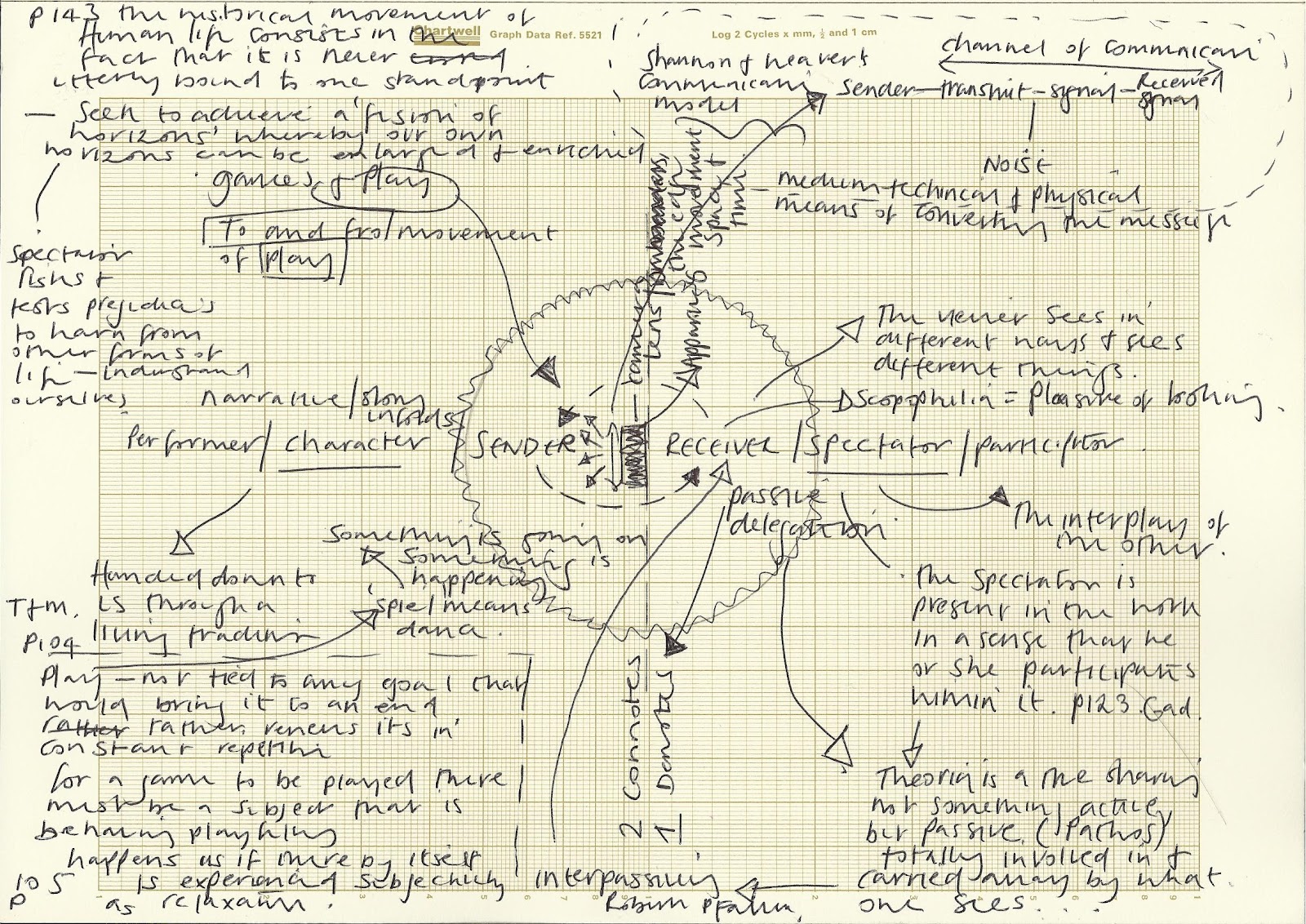
ok back..I think Im going to continue on from last posting, that is where I am now in terms of what I have been reading. the paper written on Hilary lloyd by Michael Newman has been a real inspiration to me I have made a lot of good connections, for  example, Jean louis Baudry, narrative  apparatus and ideology, (difficult reading...but i have manage to grasp some of it) focuses on the positioning of the camera in relation to the spectator, that is the viewer is taken out of the vanishing point of the image. Laura Mulvey (Visual methodologies P107) essay looks at cinema, more to the point voyeuristic 'male gaze' in visual pleasure and narrative cinema, which links to Warhol p42 stargazer. Scopophilia...the pleasure in looking and what overlaps into fetishistic scopophilia, in which Mulveys decribes the female figure represented simply as a beautiful object of display (close ups of her overwhelming beauty) as seen by the hero of the film and the male spectator. Warhol's film can be seen in the same way, his central metaphor being the voyeur, simply the one who see's...but defends himself as someone whose presence must remain unknown...p41 Stagazer. 
Also what is of interest is the term 'interpassivity' (Robert Pfaller. little gestures of disapearence) which has replaced 'interactivity' I shall try to explain this...interpassivity as I understand it means 'delegating ones pleasure' for example; watching a tv programme that contains 'canned laughter' is put there so we don't have to laugh, its already done for us, soaps in the same way are easy to follow, it doesn't matter how long you stop watching, on return you could quite easily pick up the story line, the characters etc...Warhols film are viewed in the same way 'Sleep' in 1963 we see the film remaining on the screen always, its time is dissociated from the audience, only to be glanced at from time to time, warhol is perhaps the only film maker to ever concede that his audience might not want to see every minute of his work...so when not being viewed by the audience it is then the cameras mechanical eye that does all the work..this I can link with interpassivity!


thinking about all of this...SE suggested I make a sentence of linked concepts, how they relate and frame my research. I think I am doing this to some degree, its difficult not to get side tracked there's always so much to take in. this is what I have come up with so far..


TWO-WAY COMMUNICATION, VOYEURISM, STORYTELLER/THE PLAYER OR CHARACTER, TIME-BASED=TEMPORAL, AUDIENCE/PLAYERS.


I want to continue looking in this area, its really interesting. I've ordered a book on audience studies, it relates to a lot of what I have been discussing above...although where this is leading to I'm not quite sure, I have now until September, not long to decipher what my RQ clearly states. I need to get it clear in my mind to fully understand myself. Last leg of the MA which focuses on 'reflection' and commercialisation (dull, its business)...FR has now gone and I have hopefully on board Ellie Land, she sounds quite exiciting..thats all for now. next meeting with SE. 23rd Feb 3:45 thursday. 

Saturday, 14 January 2012

Happy New Year...and some progress


Hilary lloyd Turner Prize @ Baltic 2011


Its saturday 14th January 2012...its taken me this long to get my act together and write something. That is Im not short of writting anything just haven't got round to it!! So here I am again and whats new?? well since my last posting I have submitted all modules, SE Creative Thinking 16th.12.2011 and AT Contemporary Influences 3.1.2012. Im yet to hear feedback...in particular SE as it is research developing towards the DDP. I think Im online with SE this thursday 19th?? shall just check that now whilist Im thinking about it....yes Im right @ 2:30. Thats good as I will be missing mornings session as elsewhere (must email stuart to confirm) I can discuss with him then last module submission leading into new module. ok whats next??
oh yes before christmas I was talking to a colleague about my filming and what is was very briefly about...this whole subject about 'nothing'. She mentioned referring to The Turner Prize @ Baltic that Matthew Collins had spoken about Hilary Lloyds video installations...(I haven't been able to find that review unfortunatly??). Since that conversation i have carried out some research on her work, which interestingly refers to Warhols time based media...
extract taken from http://www.channel4.com/news/turner-prize-2011-hilary-lloyd

Working in film and video, Hilary Lloyd presents sound and image to the viewer in a way which challenges and undermines viewing conventions, writes Matthew Cain.
Turner Prize 2011: Hilary Lloyd
Hilary Lloyd was born in Halifax, Yorkshire, in 1964. She studied at Newcastle Polytechnic and now lives and works in London.
She was nominated for the Turner Prize 2011 for her solo show at Raven Row in London.
Lloyd works in the perennially-fashionable film and video although unlike most other artists she draws attention to the projection process, almost making the technical equipment a sculptural medium in itself.
In some cases, these projectors can obstruct the viewing process and much of her moving images themselves toy with our viewing conventions. So while one piece in this show contains barely perceptible movement, which is at first puzzling, the neighboring work is made up of a constant flickering energy on a fragmented screen.
In another, Floor 2011, the floor represented is abstracted to a disorientating degree.
Our desire for an image that is easy to read is thwarted but replaced, at least in my case, with delight at the artist's sense of mischief.
 http://channel.tate.org.uk/media/1243804099001  Hilary Lloyd talking about her films in which she says 'It's not always clear what I filmed',

Looking abit deeper I found her work in a catalogue: Intellegence - New British Art 2000, weirdly enough sitting on my shelf...what was interesting was (p69) I quote..'using techniques established by Andy Warhol such as the fixed, deadpan camera, lloyd elicits performances that reveal both the pleasure and the discomfort of being observed...

Polly Staple (p69) sums up the relationship between viewer and the subject in Lloyds work:

'Lloyds videos articulate the engagement between the voyer and the performer, between watching and being watched, intimacy and distance, wilfulness and self control. this high degree of self-consciousness seems a particularly urban trait, it stems from moving - flaneuring-through the city, and articulates the paradoxical relationship between the desire to connect and the need to proect yourself'...
(Polly Staple 'precious time: Polly staple on Hilary Lloyd' Untitled, spring 2000, p9)

I took a trip up to the Baltic (Thursday 29th December 2011) to visit the Turner Prize, specifically to see Lloyds work which i have to say was good to see, for me the film wasn't particuarly interesting? what has been written about it is more so...what was enlighting was to see the mechanics of the video/filming equipment forming a wall between you and the subject, it all seems part of the installation, that is, it is not just about the film, but what projects it??

 Further reading Michael Newman (which I found in the TP catalogue)...has led me on to think about the function or purpose of the camera.http://artistsspace.org/aspace/wp-content/files_mf/hilarylloydbookletweb3427.pdf An extract from this book is of particular use:

Lloyd’s installations combine the duration of this kind of experience – now directed not towards an abstract object but to the projection equipment itself – with the experience of the time of the image. The virtual time of the image is folded back onto the object, facilitated by characteristics they both share, which involve both a common allure and a structure of repetition rendered potentially endless by the loop. In the process, the appeal of each dimension is transferred onto the other, so that the image becomes abstractly autonomous, while the equipment takes on sex-appeal. (That this is exactly how advertising works, and that the advertising industry was accelerating at the time of Minimalism, is probably no coincidence.) Effectively, object becomes image, and image thing.

To demonstrate that the very set-up of the situations of filming and projection reinforce the ideology conveyed by cinematic representation was the burden of so-called “apparatus theory” in the 1970s, which followed avant-garde developments in cinema, such as Jean-Luc Godard’s deconstruction of the cinematic image through the use of montage with text on the screen. Theorists including Jean-Louis Baudry argued that cinema worked through identifications not only with characters in the movies, but also with the position of the camera, reproduced in the projector hidden high up behind the heads of the audience in the dark movie house So the viewer is simultaneously implicated in the narrative of the film, and enabled to take a “transcendental” position removed from the interaction of bodies though the all-seeing camera. The critical idea of the 1970s was that to make explicit the structure and effects of the apparatus would be to demystify the ideological operations of cinema, which was up to that time the dominant mode of the mass-consumption of moving images. The problems inherent in this idea became clear when artists started presenting the projection apparatus itself in their installations. On the one hand, to place a projector – whether film, slide, or video – in the gallery space is to foreclose the viewing subject’s fantasy of occupying that position: if it’s there, I can’t be. The viewer is ejected from being the source and vanishing point of the image. This may induce a critical awareness of the way in which images work to position the subject.
The images emerge from and disappear into downward wipes set to different speeds, so that their rhythms converge and diverge. This means that while it is very difficult to calculate the relations between the moments of appearance of the two images, the viewer is somehow compelled, through the very fact of rhythm, to try. This is further complicated by the accompaniment of short, repetitious edits of recorded sound, that repeats, overlapping at times contrapuntally, and at others discordantly. That the visual wipes suggest blinks, but that one could not possibly blink one’s two eyes in the rhythm of the video, implies that the technology of the work creates a peculiar kind of sensation that cannot be contained within the limits of normal perception.
Further, this idea of the blink (visual wipes suggest blinks..eye blinks) connects Lloyd’s earlier works based on still images – those using slide-projection carousels, and the later sequences of ‘still’ images in video projections – with the moving image projections where the blank moments between images – those invisible gaps elided though perceptual delay in the “optical unconscious” of film – have been replaced in more recent works by other rhythmic devices, which bring to the surface the nothingness and disconnectedness that sustains the presence of the image. If the images can become eyes, so can the projectors. The sense of emptiness at Raven Row had nothing to do with the number of visitors in the gallery, but rather with the feeling that the installations were watching themselves; that the projectors were surrogate viewers that not only produced the images, but also regarded them on our behalf.
Im hoping that this research will look to find a possible reasoning to what I am thinking about in my own work..it all seems to be fitting together quite nicely which gives me the belief that Im going in the right direction and it will go eventually full circle that is, it will go back to the start of my learning plan where I was initially addressing the concept of  a 'two way act of communication' (refer to bridging module paper)....'At first I was looking at semiotics, i.e. connation and denotation, in specifically theories presented by Barthes and his work on The Photographic Message, 1977 and Stuart Halls work on Representation, 2010, specifically his writings on audience studies. I wanted to look at building a framework that showed how a student’s creative process could be interpreted using parts to make up the whole and visa versa, in order to interpret new understanding and meaning by the observer who participated with the process'.
There definatly seems to be a link forming (i will need to to a RM and figure it out looking at as a whole matter) I research Baudry and managed to get hold of a book from Northumbria library, Narrative Apparatus Ideology. A film theory reader, Philip Rosen. Sounds interesting doesnt it?? I was actually excited about reading it too, however this has proved difficult as its not easy to read. Yes you need to be at a higher level of thinking  which unfortunalty for me I am not, its like having to try and break a code, I find I am constantly looking up words I do not understand, or having to break down sentences...arhhhh. I have read part of chapter Ideological effects of the basic cinematic apparatus, Baudry, which is why I had a go, it basically discusses 'objective reality' and the camera. the idea of 'objective reality' and how I understand it is OR (objective reality) is outside the mind i.e. a chair is a chair as seen by all...we know that, but if we think about SR (subjective reality) I personally see the chair as not a chair but perhaps something else....its almost like seeing something new for the first time or even coming across a new word for example, everybody else knows what it is or what it means except you, which should be a good thing because at that point of time you are not part of the OR crowd, its when you know and understand then you become part of the OR and then SR kicks back in (your personal view may still differ even after taken on OR...) does this make sense..hope so.
I shall read this chapter and others and come back to discussion in next posting. 


Sunday, 11 December 2011

A day full of inspiration and pants!


Pipolitta Rist @ Hayward
Up at 5am today to catch 7.15 train from leeds to London. A great day, I have to say, the negaitive is it went so quick! The morning was spent at the V&A where I attended 'The power of Making' interesting start...with the curators talk about how craft is settinga new landscape within creative industry...and then it died a little , the interiewee was rather annoying! I sat next to a lady form the design musuem and we talked briefly. I wonder what its like to have a job as a curator in such a wounderful place as the Design musuem, imagine all the interesting people you would meet and all the interesting work you would see and be involved in?? I remember seeing Martino Camper there a few years ago..he had produced 100 chairs in 100 days...the whole room was littered with chairs made from chairs. I mention him as he was one the designers due to speak at the event, but because of illness he could not make it...damn shame!!  see extract below...
.

6 September 2011–2 January 2012

The Porter Gallery
Room 48
Admission free
The V&A and Crafts Council celebrate the role of making in our lives by presenting an eclectic selection of over 100 exquisitely crafted objects, ranging from a life-size crochet bear to a ceramic eye patch, a fine metal flute to dry stone walling. Power of Making is a cabinet of curiosities showing works by both amateurs and leading makers from around the world to present a snapshot of making in our time.
The exhibition showcases works made using a diverse range of skills and explores how materials can be used in imaginative and spectacular ways, whether for medical innovation, entertainment, social networking or artistic endeavour.
Making is the most powerful way that we solve problems, express ideas and shape our world. What and how we make defines who we are, and communicates who we want to be.
For many people, making is critical for survival. For others, it is a chosen vocation: a way of thinking, inventing and innovating. And for some it is simply a delight to be able to shape a material and say ‘I made that’. The power of making is that it fulfills each of these human needs and desires.
Those whose craft and ingenuity reach the very highest levels can create amazing things. But making is something everyone can do. The knowledge of how to make – both everyday objects and highly-skilled creations – is one of humanity’s most precious resources.
Guest Curator, Daniel Charny

Daniel Charmy taked passionatly about how it important Craft is in society in particular creative industry. Craft is running forward together with digital technology..this made me think that if the traditional elements of craft is so important then why in education are we losing our ceramics, darkrooms and printrooms to settle for digital..??? its a scray thought that in 10-20 yrs time all this will be lost to the future, students will have to look up how to process a film on wikipedia if they want to know the technique...and do it themselves at home, thats of course they can still buy the developer?? crazy. This notion was confirmed recently when a lecturer from the BA photography course at Hull could not believe that we still had a dark room, as far as he was concerned it was wasted space and we at Harrogate still lived in the dark ages...Of course we engage in digital technology..yes!! but what about the wounderful process of being able to actually make something, physically I mean...to feel the material your working with, to smell it, for it to evolve before your eyes I have to say is the best thing of all. So then why cant both craft and technology in education run pararel together, why I ask does the traditional have to be phased out if there is such an upsurge of craft in industry???    

http://www.vam.ac.uk/channel/happenings/exhibitions_and_galleries/power_of_making/

Ok the afternoon was spent at the wounderful Hayward Gallery, on the southbank, I love this gallery and this part of town, the walk across the bridge from embankment to southbank is breathtaking. I always have to stop and take in the the city's skyline. Anyway back to the Hayward, currently showing is Pipilotti Rist. PR is a video/installation artist, sculptor who produces colourful themed projections on a large scale, underpants chandelier (see above image) to handbags and shells with little narrative projections staring out. wow i was and am so inspired. http://www.youtube.com/watch?feature=player_embedded&v=uKR-QhjOz-o    

Video...Pipilotti Rist made her first experimental videos in the late 1980s. These were single-channel videos; works that involve a single tape, one playback device and one display mode, such as a TV screen. While music plays a large part in these, Rist’s main interest is in the perceived failings and shortcomings of video. "I’m interested in feedback and generation losses, like colour noise and bleeds. In my experiments with video it becomes clear to me how these supposedly, faulty, opportune images are like the pictures in my own subconscious."


Installation Soon after making her first experimental videos, Pipilotti Rist started creating environments that influenced the way in which her works were seen. Videos are projected in unexpected ways in order to manipulate scale, context and the position of the spectator. Works are projected at angles on the wall, or onto the floor so that visitors can move in and around them, and also become part of them. Over the years, Rist has progressively redefined this relationship between audience and art work, creating all-enveloping visual environments that place particular importance on the viewer’s physical presence. Rist comments: ’When I close my eyes, my imagination roams free. In the same way I want to create spaces for video art that rethink the very nature of the medium itself. I want to discover new ways of configuring the world, both the world outside and the world within.’ These immersive installations are, in effect, an invitation into a parallel world – into Pipilotti’s world


Sculpture Rist began to make sculptural works in order to escape the confines of the two-dimensional screen, and to open herself up to multiple possibilities. By combining videos with everyday objects, she changes their nature and imbues the most ordinary events or objects with a sense of wonder. Believing that the objects that surround us contain memories and have stories to tell, Rist integrates video projectors and screens in unexpected things and places: tiny monitors are hidden in handbags or displayed on a gigantic lettuce, projectors are placed in a watering-can and a hanging saucepan, and a book, a vase and a chair are all used as projection surfaces.


Thursday, 8 December 2011

I try to think of what time is and all I can think is...''time is time was.'' Warhol

Working on the 'Creative Skills' module has got me thinking about what I have achieved this year...which if I think back is quite abit.
1. becoming Web 2.0 friendly or not (the negatives first) i.e. social networking, that is facebook, which I can proudly say I am no longer part of. I say this simply because Im not interested in other peoples buisness, or do I want them to know my personal activity...enough said. I also looked at twitter another waste of time a 140 something characters to put your voice across, where do people find the time..? I have 50 followers, why? where did they come from?? I haven't said anything, just joined up (that reminds me I must come off that too)!!. Ok so I have presented the negatives first thats because Im saving the best till last and that is blogging..!! yes dear 'blogger' friend you have motivated to write again, to express my thoughts in a quick, organised and clear manner which I cant do if writing in pen? writing a blog has also allowed me to ramble privately what ever comes to mind, reflect, problem-solve, post up new findings / research and develop...(until DDP is complete this is how I wish it to stay). who would want to read my blog anyway?

2. using a mac! which I have started to use lately on reqular bases, why was I ever frightened, seems crazy? anyway the reason being is working with film, which when I think about it im not sure how it came about...just had this sudden urge to make film.( will have to look back previous postings) As a result of this urge, Ive learnt how to create film, download onto imovie and edit (30.11.2011). Editing is going to be the hard bit, that is, knowing exactly what to cut. My theory is to edit every 2nd or 3rd frame and then from there assess and work on again...get it down to 8/10 mins (some films are an hr long) and speed up, the car jouney Im considering reversing the film so that I now following the car that was behind me, it will be like driving looking through the rear view mirror...not sure this make sense but i know what I am thinking about here. something that I have consider is that the films Ive made need to shorter, easier then to edit down. However the project I have in mind will not require editing, I want them to run, to think about what could happen..i discussed this in last posting..what i have thought about now is to set up 2 cameras one where there is nothing going on the other where there is, Im going on this theory of metaphysics, of time and space and that 'nothing' in context (is) relevant to someone/something, somewhere, sometime, somehow...I like this idea of watching 'nothing' in the hope that something will happen, and at the end of watching it was it relief that nothing happened or disappointing because it would have been good to have something to look forward too??? ummm.......

Im currently reading Andy Warhol: the philosophy of Andy Warhol..its great! really enjoying his writings, amusing too. I need this book at the moment, funny how things come into your life when you least expect them too. Serendipity i guess. furthermore this book only came about because my colleague had mentioned Warhol's 8 hr film of the Empire state building, which got me thinking about he's reasons for creating film..this book does illustrate this briefly in chapter called 'work', but it refers to his reflections on himself, which I can relate to and what encourages me to think about my own practice. Ive just thought that I need to list films made so far...November 2011. Letter box (1hr) car journey (1hr 20) cat flap (20 mins) radiant map (5-10mins) student films (1hr) 

3. writing a paper. (difficult at times) Im not sure Im a writer in the academic sense its gaining that experience, writing papers are all about presenting structure and being able to write in a particular way and importantly to demonstrate new knowledge..I like to write freely which means not having to worry that Im not doing it correctly... this attitude wont get me anywhere so I shall keep on with..the plus is I definatly think I have developed my writing skills over the past year. I like words, I wish blog you had a thesaurus??

Moving on..
This posting started as a reflection of what I have achieved this year...I needed to do that, not sure why but its there now and will no doubt contribute somewhere later on. As result of writing it down this years achievements, it has presented futher considerations to the outcome of pursuing such activities. For the purpose of the module I now want to think about the radiant map. I want to get it clear in my head what it is i want to discuss and how..illustrated below are areas I have had to consider when defining 'problem space' within my learning contract.. 

elements required to form  new knowledge


Development of radiant map


As applied in a game I have used cards to write down reflections, actions and evaulations created from links that is threads of thought, my ideas created using letra set onto acetate to move around the board. By means of raising the acetate I realised that the words formed shadows on the board, this interested me and what made me think about Plato's, The Allegory of the Cave, extract taken from Wikipedia:
In the dialogue, Socrates describes a group of people who have lived chained to the wall of a cave all of their lives, facing a blank wall. The people watch shadows projected on the wall by things passing in front of a fire behind them, and begin to ascribe forms to these shadows. According to Socrates, the shadows are as close as the prisoners get to viewing reality. He then explains how the philosopher is like a prisoner who is freed from the cave and comes to understand that the shadows on the wall do not make up reality at all, as he can perceive the true form of reality rather than the mere shadows seen by the prisoners...To consider the shadows created from my process of thoughts could be likened to universal concepts advancing to new knowledge.
The Allegory is related to Plato's Theory of Forms, according to which the "Forms" (or "Ideas"), and not the material world of change known to us through sensation, possess the highest and most fundamental kind of reality. Only knowledge of the Forms constitutes real knowledge. In addition, the Allegory of the Cave is an attempt to explain the philosopher's place in society: to attempt to enlighten the "prisoners".